Her Eyes
People come in pointing at a feature. She is looking at something else.
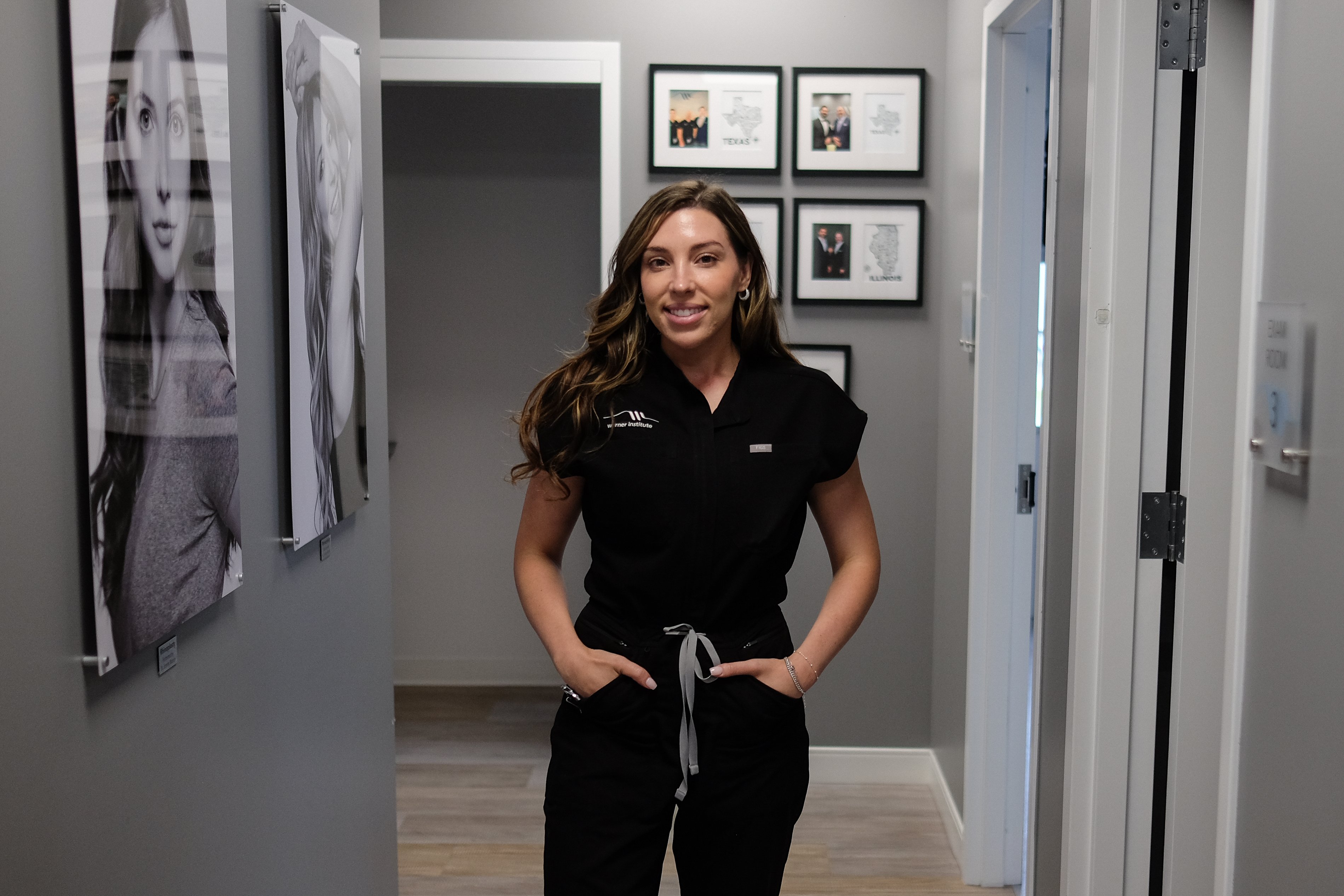
Black and white portraits hung along the gray wall as I walked to Alyssa Nasman's treatment room. I felt drawn to them, and to what they were doing in a clinic that treats faces. How does a portrait say more with the color taken out of it?
Then I arrived at her room. Gray as well, with a black treatment chair in the middle. It felt clean and cold, the way those rooms are.
"Welcome to my room," she said. Her voice added warmth and her eyes did more. There was something in them I could not name yet.
That was the question I brought with me as I turned on my recorder. Her eyes, and what they were holding.
So what do we want to talk about today, she asked.
I told her I had seen her talk about facial balancing on her account, and asked her what it meant to her.
HALF A FACE
"Gosh, this term gets thrown around so loosely," she said.
It has nothing to do with symmetry. "The most attractive people in the world have very asymmetrical faces." Split any face down the middle and one side sits higher, the other runs longer and leaner. That is how everyone is born.
"Facial balancing is bringing light to areas of shadow that you want to have light reflection," she said. "For instance, when you look at a baby they're beautiful, they're plump, they've got so much light reflection. So we think they're youthful." Later it runs the other way, the temples hollow and darkness comes into the under eyes and around the mouth. "We associate light reflection with youth and shadows with aging."
I asked her what her favorite case has been.
A patient born with a trigeminal nerve injury, who could not use half of her face. "She could not smile on half of her face. She didn't have the ability to frown on one side."
A surgeon took muscle from the woman's leg and rebuilt the smile. Then she was referred to Alyssa. "I built out more light reflection on a side that she had a lack of volume," she said. They treated that side with Botox as well. "We botoxed only one side of her face because she was only able to make an angry face on one side."
Then the cleft lip patients, where she is building a lip that was never there in the first place. "Those are really rewarding cases," she said. "Those are my favorite cases."
Those people don't sit in here and go, I want perfection. I just want a sense of normalcy.
She was proud telling me this, and it showed before she got to the end of it.
ASK IT TWICE
I asked her what people come in for.
"I typically tend to ask it twice," she said. The first time it is a part of the face. "They're like, you know, it's my under eyes or it's my mouth." Then she asks again. "But why is that bothering you?"
"Typically, they associate it with being tired," she said. "It's more of an emotion."
"Angry, sad, and tired are the trifecta of things that people don't want to be associated with," she said. "People want to be associated with happy, energetic." She said there are psychological studies on how people are perceived and treated based on their facial expression.
Then it goes further down. "Sometimes I've gotten so deep with a patient," she said. "They're like, I don't want my under eyes to look like this because I don't like my dad and I look like my dad." Another told her that her mother never took care of herself, and she looks like her mother, and she does not take care of herself either.
"I hear the most deep and intense things in my chair very quickly," she said. Within thirty minutes of meeting someone.
I asked her where it starts. Other people, mostly. "A lot of insecurities are deeply seeded from other people," she said. Someone walks up and asks if you are feeling okay, you look a little tired. "That sits with you. That sits with you for a while." Then somebody else says the same thing. "Now you have double validation that now you look tired."
HER NO'S
Two years ago she went to a training and brought a friend as her model. Another injector looked at her friend and said she looked quite masculine, and suggested taking the jaw down.
They saw each other on a girls weekend two weeks before we spoke. Her friend does not remember what was done to her face that day. "I never stopped thinking about how masculine I look," she told Alyssa.
"I didn't see it. Somebody else did," Alyssa said.
It is why she will not open with what she would change about you.
I don't like coming off the bat like this is what I would fix about you, because then I create insecurity.
Name things she cannot deliver, and "now you have three things you can't focus on. I created damage."
So a lot of the job is sending people elsewhere. "A big aspect of what aesthetics is, is also being able to recognize mental health issues," she said, and being able to tell whether it is an actual physical flaw she can address or something deeper that needs talking through. Tissue that will not hold goes to a surgeon.
She also refers people out on skin. What is safe to laser or microneedle on one person is not safe on another, and she would rather send someone to a provider who treats their skin type every week than treat it herself.
She has a line she says often enough that her patients can quote it back to her. "If I don't treat you today, I still can go home and eat." There is no reason, she said, that she should ever have to treat you if you do not need it.
Then there is the kind that arrives already done. Overfilled patients are usually the last to know, and they hear it from family first. She puts an ultrasound on them to show where the filler actually sits, then takes it out, session by session.
"You look like yourself again," the families say.
"Instead of adding anything to their face, I just took out."
MY TURN
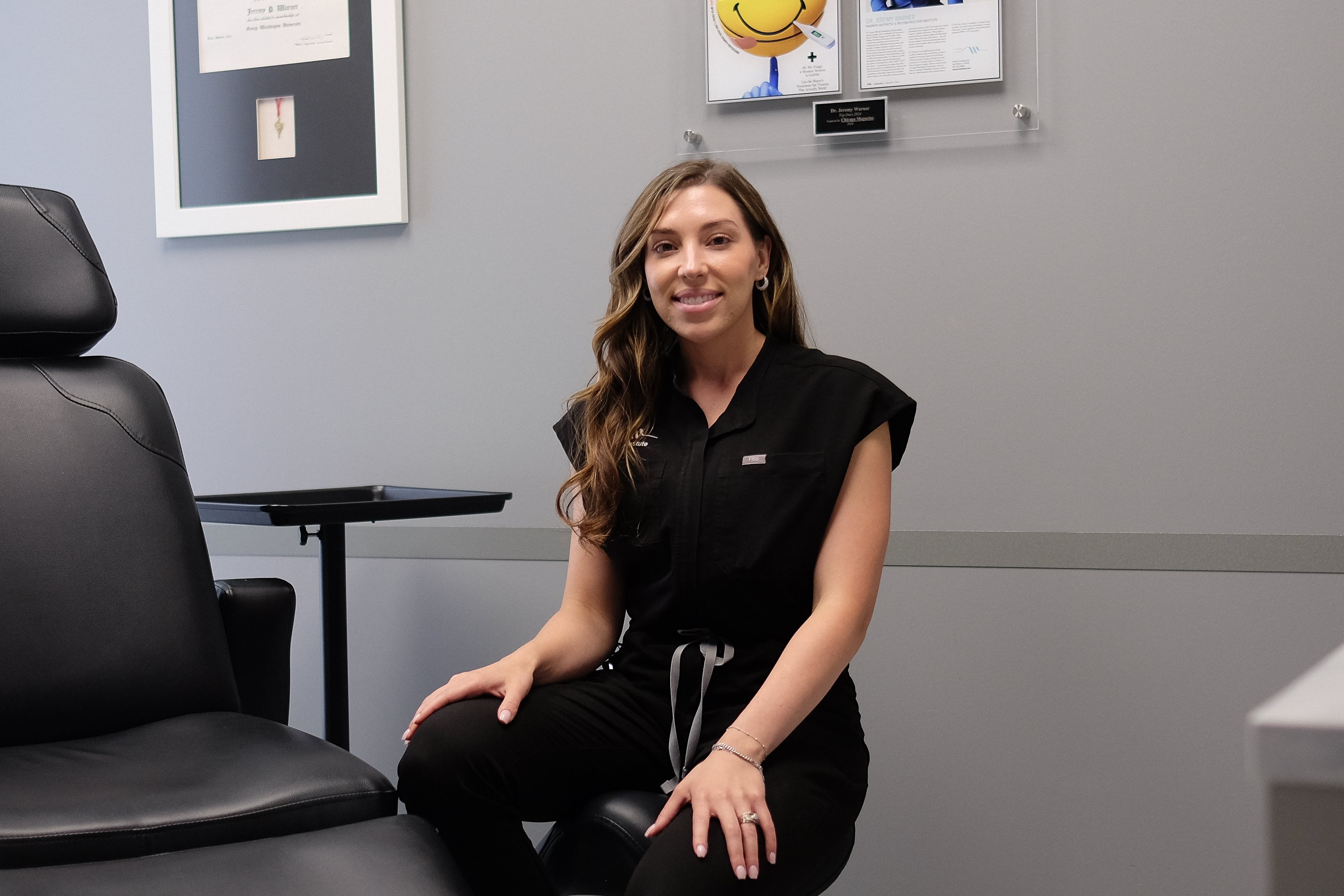
I said let us do something so I can write about it more personally. Let me be a pretend patient. I want to see how it works.
"So my first question right off the bat is what would bring you in?"
One of my eyes is a little smaller, I said. I always see it in photos.
She asked how I felt about it. Then she said something about photographs that I have not stopped thinking about.
"You're not seeing yourself in real time," she said. "You're always seeing a reflection of yourself." You cannot see it outside of your body.
Then she picked up the handheld mirror from her table and turned it toward me.
She asked me to make an angry face. Then she pointed at the bone above my brow. Forward on one side, set back a little on the other. Less support there, so the brow sits lower. Millimeters lower, she said, and that is where the shadow falls.
Everyone is formed like this, one side wider and one side longer and leaner. Some patients want the rounder side and some want the leaner one. She can add support where there is less of it. She cannot take it out of the side that already has it, and she cannot change bone.
I can only change the way that the light reflects.
She said a tiny unit would pop the brow up if the symmetry mattered to me. Then she said it was not something she would necessarily treat. She looks at faces all day, and when she met me she did not look at my brow and think anything was wrong with it.
THE FLOOR
She was the kind of child you could put paint in front of. "If you couldn't entertain me, you put paint in front of me. I could sit there for two hours."
It is where the name comes from. The gloss injector. "It's not because I like gloss," she said. "It's because I like light reflection off of paint." She looks at a face the same way.
She also knew from high school that she wanted to be a nurse. "I've always had a science brain and that's just how I work."
She started in medical surgical oncology. Post-op procedures, a lot of direct floor contact. Then the floor became a full COVID unit. "That full-fledged COVID unit burnt me out like crazy," she said. Patients she had cared for died there.
Her husband was the one who said it out loud. She was coming home carrying it, and one evening he told her. "You are so sad at the end of the day. You need to change."
A friend who worked the front desk at a med spa gave her the direction. You have always been into beauty, she said. You have always been into fashion. Why not the aesthetic side of medicine. Go to a training and see if you even like it.
The training cost more than a thousand dollars. "A lot of money to maybe like something," she said. She went for one weekend and never looked back.
NO BOOK
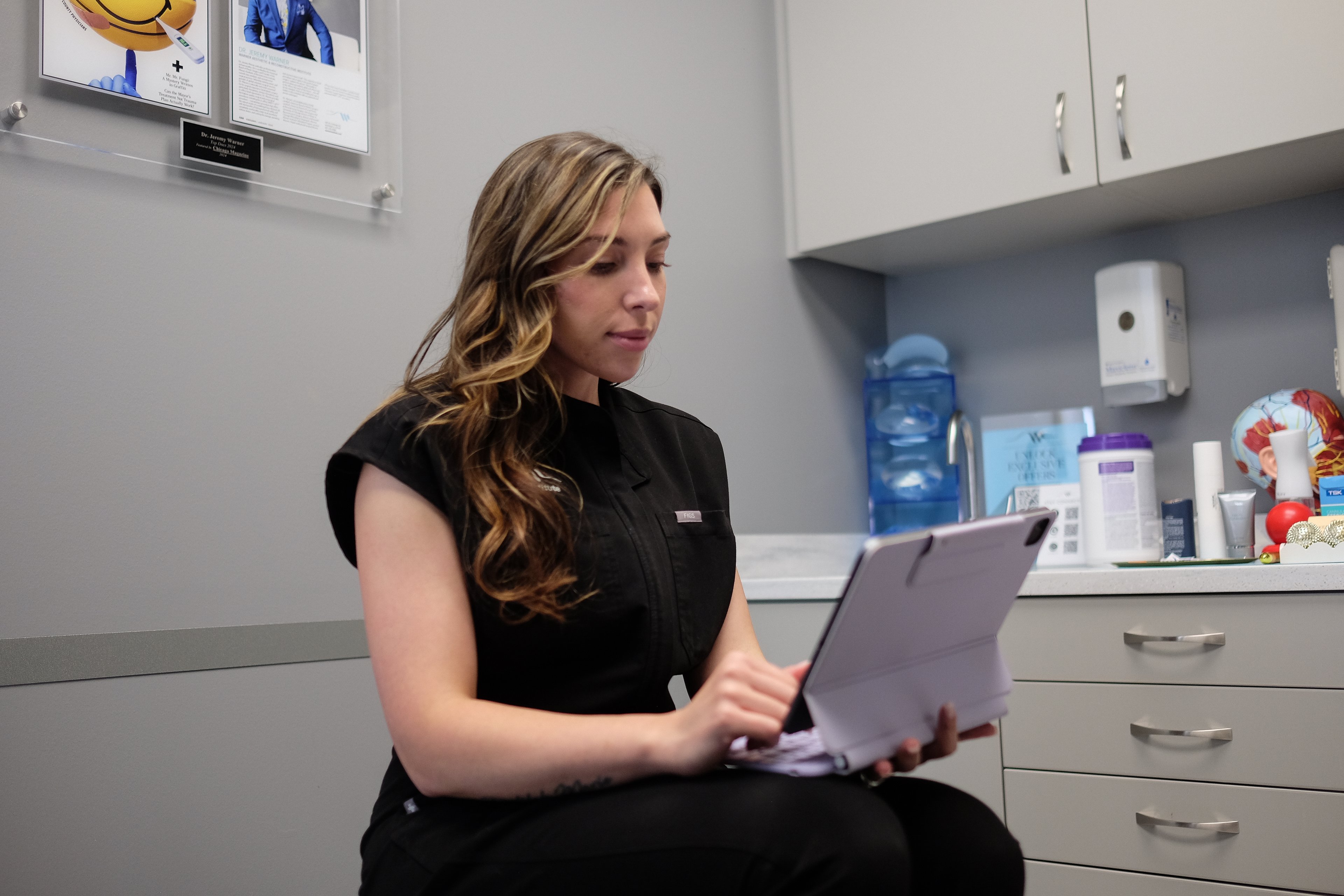
She was already a nurse when she took a job as a medical assistant to a nurse injector, and built her skills from there. Five years in aesthetics now, two of them here.
"I would say where I really took off was here," she said. "I really think that I've honed in on my craft at the Warner Institute."
I asked what made her confident enough to treat people. She would not give me a clean answer. "Confidence is a weird and tricky thing," she said. "I have confidence but I don't know everything." What taught her most was fixing her own work. A brow left heavy. Something that had to be corrected. "Definitely having to correct things, you learn the most for sure."
She always thought she would want something of her own one day. "But truly I love working with, I think I love working with other providers," she said. "I love the safety of working with another provider but I also just love bouncing ideas off of other providers." Not owning it is a relief on top of that. "I love that I don't own this business," she said. No payroll, no front desk.
At the med spa she came from, a medical provider signed off on charts from somewhere else. In this building there are two plastic surgeons seeing patients and an operating room down the hall she can walk into and watch. Some of what comes through is rare enough that nobody has written it down. "Sometimes these are cases where ten people in the world have something like this happen. There's no book on how to treat them."
People assume the job is a soft one. "I think at the end of the day people think this is a no-pressure job and there is still a lot of secret pressure that sneaks in," she said. She is watching for a blocked vessel, a dropped lid, a smile that comes back crooked. What she said she never wants to do is make somebody look worse than when they walked in.
What she wanted was the other thing. "I'm not just a nurse here. He values my opinion as an equal colleague." There are a lot of places, she said, where people will say you are just a nurse. This is not one of them.
"I love it here."
She left the hospital but brought the science with her. She is still looking at faces, and the science brain is still doing its work. What changed is that she does not wait on anyone else to decide anymore.
"A lot of patients are there because they have to be, not because they want to be," she said. "So in this realm, people want your help. They look forward to seeing you."
The portraits were still in the hallway while we did the photos. Take the color out of a face and what is left is structure, light and shadow. That is what she works with all day.
And her eyes. I could name it by then. Her mouth had spent the morning on bone and light and the things she will not do. Her eyes had been saying something simpler since I walked in. She is happy where she landed, still learning, in a room that fits her. Somebody looked at her face once and told her what it was saying and it moved her whole life.
She has spent every day since doing that for other people.
Questions worth asking your injector
Alyssa's approach can be translated into a short list of questions worth asking any injector. She did not give me this list. I assembled it from the way she practices.
What is an ideal face to you?
She does not have one. She says the work is not about everyone having an Instagram face and everyone looking the same, and that the most attractive people in the world have very asymmetrical faces. Ask anyway, because an injector who answers with a look is working toward a template.
When would you tell me to do nothing?
She says no often, and she says the patients she turns down are the ones who trust her most. A small line at forty, a little jowl at seventy, a brow sitting a millimeter lower than the other one. Ask what an injector would leave alone, and listen for whether the answer is anything at all.
How long will this actually last?
Filler is sold as lasting six to twelve months, maybe eighteen. She calls that a fallacy. She has dissolved lips at four years and under eyes at eight, and she says it is never a problem if it lasts, as long as it lasts in the right place.
How often should I be coming back?
She tells patients she should not be seeing them every month, and asks for at least three between visits. Coming in more often trains your body to metabolize it faster.

Exploring artistry and the spaces in between.