The Long Game
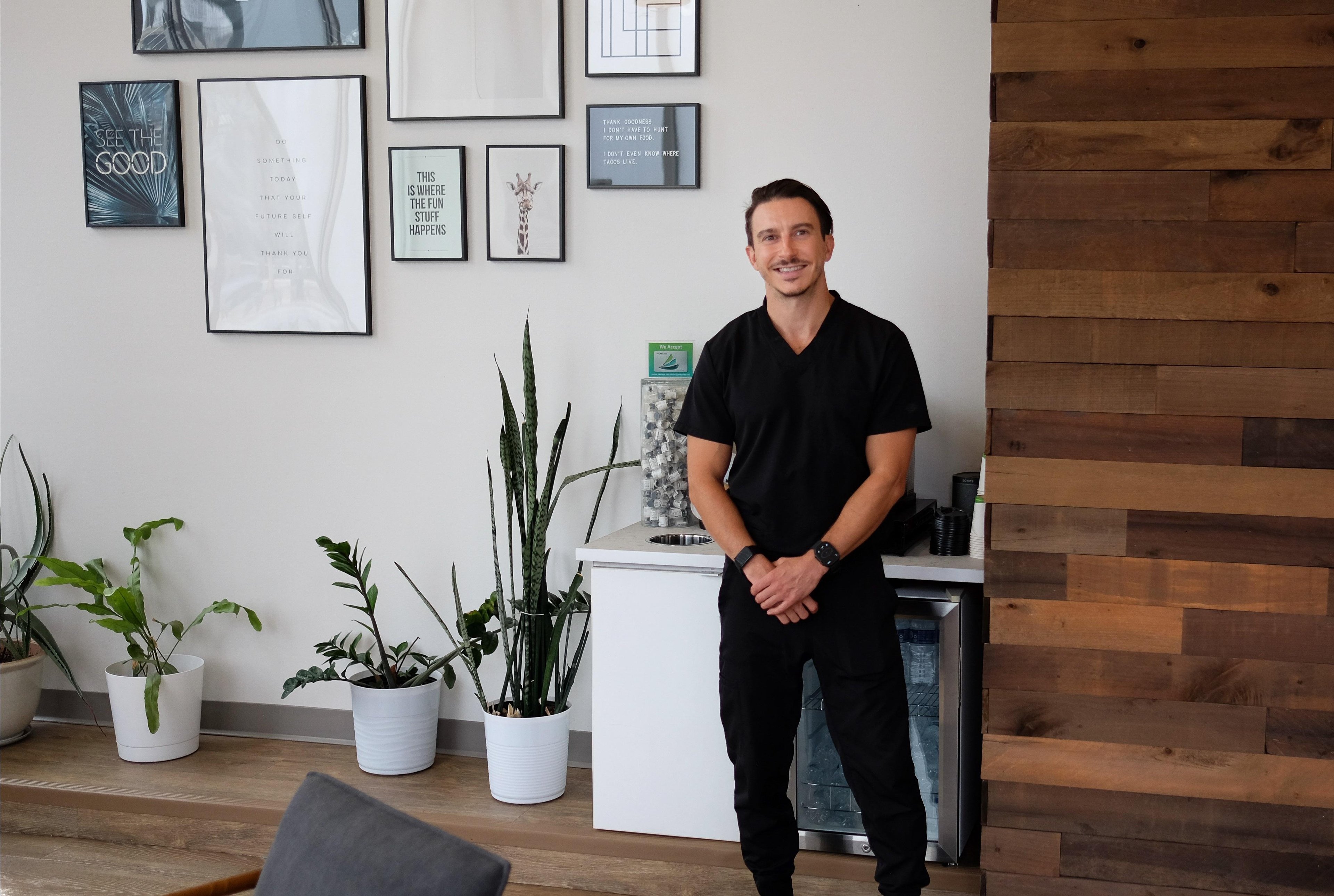
Inside the Wicker Park dental lounge of Dr. Jack Geissler, a young dentist building a practice on his own terms.
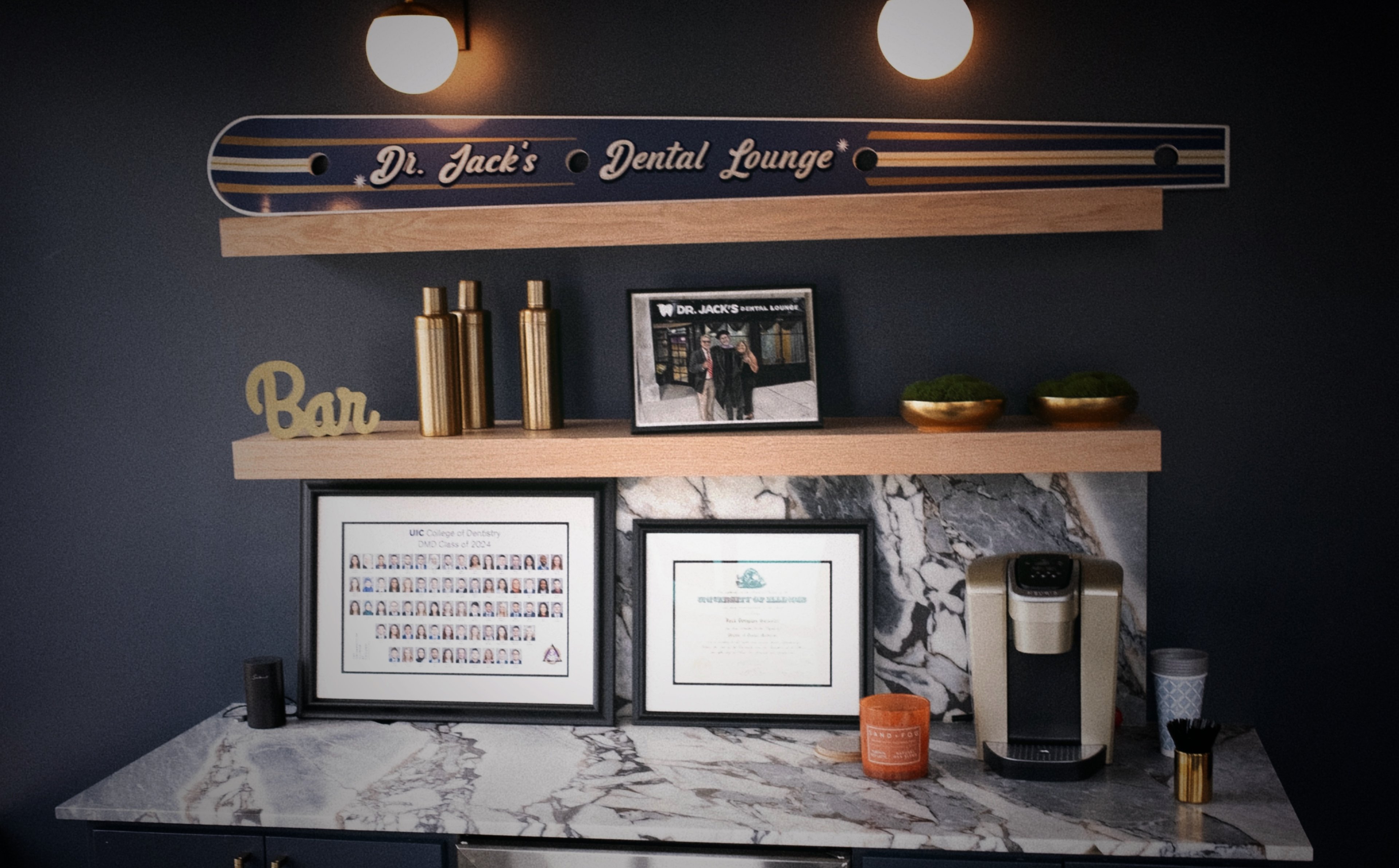
I arrived about an hour before Jack's first patient, and the lounge was already quiet, the lights just coming on. A glass-front fridge hummed softly against the wall, stocked with Pepsi and Vitamin Water. Above it, a shotski, hand-lettered in cream cursive on navy, ran the length of the shelf. Dr. Jack's Dental Lounge. A watercolor caught my eye first, propped on the shelf between a brass thermos and a small bowl of moss. Jack in graduation regalia, standing in front of the storefront, his parents on either side.
In one of the treatment rooms, framed album covers by ODESZA and Zeds Dead hung at eye level. Festival electronic artists, the kind Jack listens to on weekends with friends. Neither would be playing today. The music he puts on for patients is slower, designed to keep the room at a low hum. "It's different from what I actually go out and listen to," he tells me. "We're trying to keep it chill." The posters are who he is on Saturday night. The playlist is who he is on Tuesday morning. The patient sits in the middle.
Jack Geissler is twenty-eight years old, and this is his. A business loan signed a year and a half out of dental school, a building in Wicker Park, two chairs, one assistant. The industry around him is consolidating into chains, diagnosing with artificial intelligence, and recommending procedures to patients who do not need them. Jack is doing none of it.
This is what I started thinking of as the long game.
INHERITED DISCIPLINE
Jack's mother has been a dentist in Joliet for nearly forty years. She opened her own practice there not long after dental school and has run it ever since. Jack watched her be a business owner and a doctor at the same time, and what stuck with him was not the income or the title.
"The one thing that stood out the most was that I saw how long she enjoyed it for," he says. "Year after year after year. I felt like this is something I could see myself doing too."
For a long time his mother tried to convince him to go to medical school. He chose dentistry instead, and he chose it for a specific reason. "I just really liked the hands-on and artistic side of dentistry a little bit more," he tells me. He chose the work, in other words, before he chose the career.
The office we are sitting in now came to him through his mother, but not in the way those sentences usually go. One of her dental school classmates, a man named Dr. Dejean, posted on Facebook that he was retiring. He had been running this practice for over twenty years. Nobody was taking it over. Jack's mother saw the post, commented, texted her son.
Jack went to see the space. He met the landlord. He ran the numbers on the loan, the lease, the equipment, the renovation, the cushion he would need during the startup year when almost none of the previous dentist's patients would return. He worked out what would happen if everything went wrong. "Even if all of this goes downhill, even if I have no patients, I could still have managed to get a part-time job somewhere else and work at my mom's and cover those expenses," he says. "That's the only reason why I was like, okay, I can do this."
His parents co-signed the loan. He says this plainly, without defensiveness. Then he built the practice.
THE TRANSACTIONAL YEARS
Before there was a practice, there was tennis. Jack grew up playing competitively in the suburbs, one or two tournaments a month, year-round, all the way through high school. He was a student athlete, not a student worker. His parents worked full time so he did not have to. He played instead.
But tennis was not only a game. It was also how he was paying for college. Dental school has almost no scholarships. Undergrad does. So tennis, for the entirety of Jack's adolescence, was a long and deliberate negotiation with his own future.
As much as I loved it and had a passion for it, it was also very transactional.
"As much as I loved it and had a passion for it, it was also very transactional," he says. "The entire time that I was playing, we were thinking about how much scholarship money am I going to get in undergrad, because we knew how expensive dental school was going to be."
The word transactional lands differently coming from someone who is twenty-eight. It is the kind of self-awareness that often takes years to arrive at. Jack had it about his own life while he was still living it. He worked hard because he loved the game, and he worked hard because the game was buying him something else. Both were true. He does not pretend otherwise.
Dental school ended the tennis entirely. The first two years, he tells me, he did not have a life. "I remember a stretch of time, I think I went six or seven weeks, like all I did in a row was study and do school. I didn't go out with friends or anything."
What those years taught him, I think, was how to sit inside a long and quiet effort that does not pay off immediately. The work ethic tennis built carried him through dental school. Dental school carried him to the moment his mother texted him about the space. The space carried him here, to an hour before the first patient, to the lounge with the lights just coming on, to the glass-front fridge humming against the wall.
Now, a year and a half in, Jack is figuring out what comes after transactional.
THE LOUNGE
The name was deliberate. Jack did not want a generic dental office. He did not want a zip-code name. He did not want Wicker Park Dentistry. "I knew that I wanted something personal to me," he says. "I had this vision that I wanted an office that had my personality embedded into it."
The name came from a family brainstorm. Dr. Jack. Dr. Jack's what. Dr. Jack's Dental. Dr. Jack's Dental Studio. Dr. Jack's Dental Lounge. The last one stuck because of the music.

There are two chairs in the office right now. His, and one for a hygienist he is hoping to hire in the next six months. In the back of the space, a third treatment room sits empty, waiting. Jack is certified in Botox and offering injections. The plan for the third chair is bigger: a nurse injector working injectables alongside the dentistry. An integrated dental lounge where therapeutic and aesthetic work sit under one roof. Small, not scaled.
When I ask him where he sees the practice in ten years, Jack does not describe a chain. He describes, at most, a second location. Maybe his mother's practice in Joliet when she retires. Maybe one more somewhere in Chicago. That is the ceiling he has set for himself, and he is clear about why.
"As you have seen with other dental chains, they typically expand, and then I personally feel like they get caught up in the expansion, they get caught up in the money," he says. His vision, he makes clear, is not like that.
I wouldn't want my philosophy to be compromised by other people's influence.
He will not take on shareholders. He has thought about this. He would sell the business first. "I don't think I would ever want to give up control," he says. "I wouldn't want my philosophy to be compromised by other people's influence."
THE RETURN
For a long time after dental school, Jack did not play. The first couple of years of running the practice, he tells me, were like dental school all over again. His life was the work, and there was nothing on either side of it.
Then, recently, tennis came back. He joined a league in Chicago. He plays once a week. Compared to the tournaments of his adolescence, it is almost nothing. Compared to the first eighteen months of owning the practice, when he barely saw his friends, it is a recalibration. The stakes are gone. The game is not.
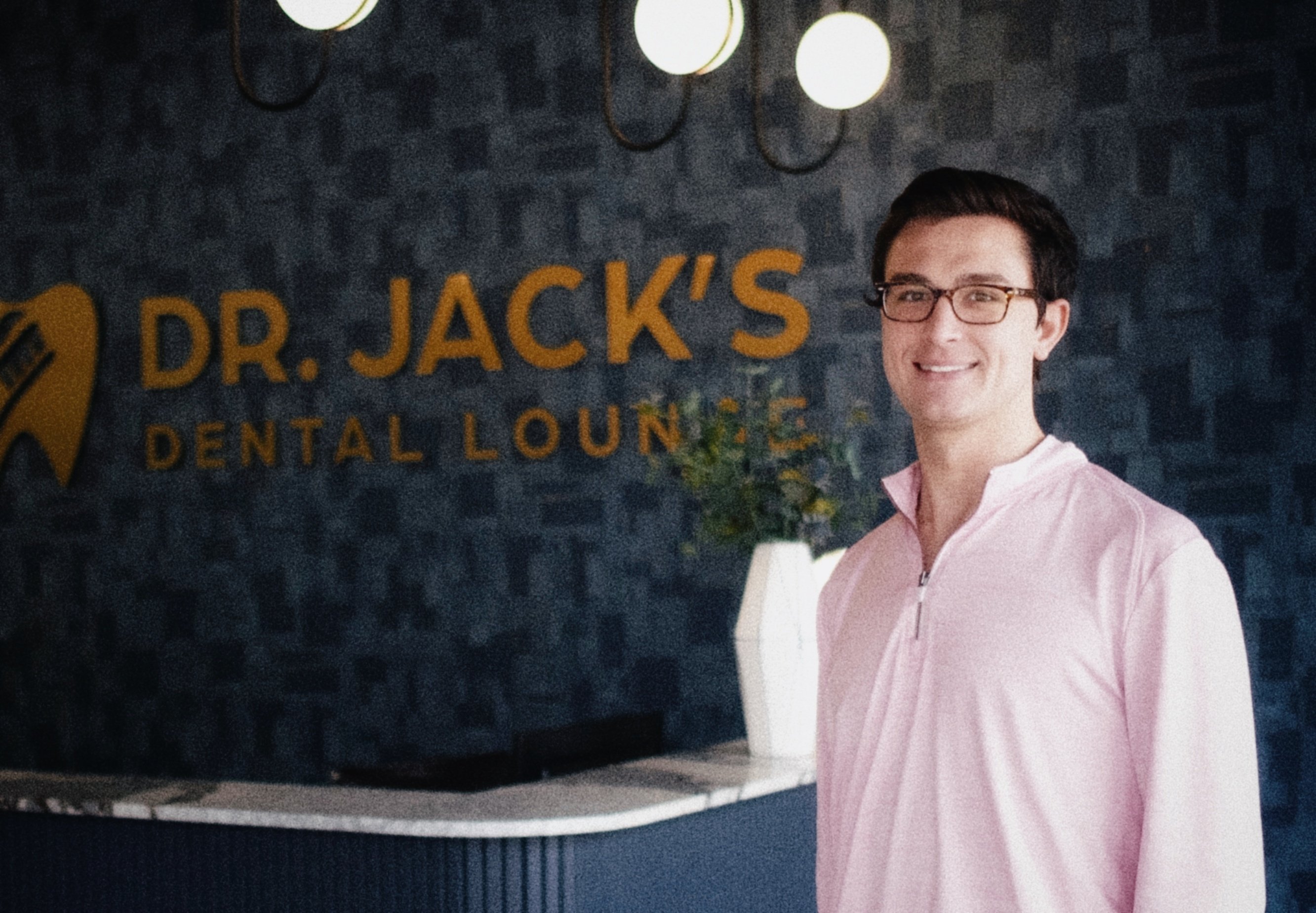
The version of tennis he is playing now has no scholarship attached to it. It is the thing itself.
That same instinct, I have started to notice, shapes the way he works in the chair.
"I require two pieces of evidence in order to actually treatment plan something," he says. One radiographic, meaning something visible on the x-ray. One clinical, meaning something he can see or feel on the tooth itself. If he has one and not the other, he often waits.
A dark spot on your x-ray does not automatically mean you have a cavity.
"A dark spot on your x-ray does not automatically mean you have a cavity," he tells me. "You have to look at it. You have to feel it. Sometimes people's enamel is just thinner in some parts. It's different for everyone."
He is skeptical of the AI x-ray diagnostics being adopted in dentistry right now. They flag any little dark spot. "People are getting fillings for that, which is not right in my professional opinion," he says.
"I've gotten people from other places, been like, I was told I had six cavities, and I'm like, you have no cavities," he says. It happens, he tells me. Patients are easy to take advantage of because they cannot read their own x-rays.
He says "you guys" when he means patients. He includes me.
His prices are set at the fiftieth percentile for his zip code. Not premium. Not discount. Average, deliberately. He refers out hard root canals and complex surgeries to specialists because specialists exist for a reason.
"One of the ways that I have been able to build up a patient base is by being honest and transparent with patients and not over-prescribing unnecessary treatments," he says. "The more fair you are, even though it doesn't cost more, the farther I think it's going to take me."
"People talk," he says. "Luckily for me, people talk."
Questions worth asking your dentist
Jack's clinical philosophy can be translated into a short list of questions worth asking any dentist before agreeing to treatment. He did not give me this list. I assembled it from the way he practices.
Can you show me both the radiographic and the clinical evidence?
Jack will not treatment plan a cavity unless he has two pieces of evidence: something visible on the x-ray, and something he can see or feel on the tooth itself. If your dentist has only one, a reasonable answer is to wait and watch the tooth at your next cleaning.
Is there a more conservative option before we do a veneer?
For most aesthetic concerns, Jack recommends Invisalign and whitening before anything invasive. Orthodontics and bleaching do not change the structure of your natural teeth. Veneers, crowns, and composite fillings do. The order matters.
How are you using AI in diagnostics, and how do you weigh what it flags?
AI x-ray tools tend to flag any little dark spot as a cavity. Some dark spots are not cavities. A good dentist will tell you how they weigh AI findings against clinical examination, and what they do when the two disagree.
What would you refer out to a specialist?
Jack refers out hard root canals and complex surgeries because specialists exist for a reason. A dentist who says yes to everything is a dentist worth a second opinion.

Exploring artistry and the spaces in between.