Nothing is draining.
The story the roller is sold on, and the one thing it actually does.
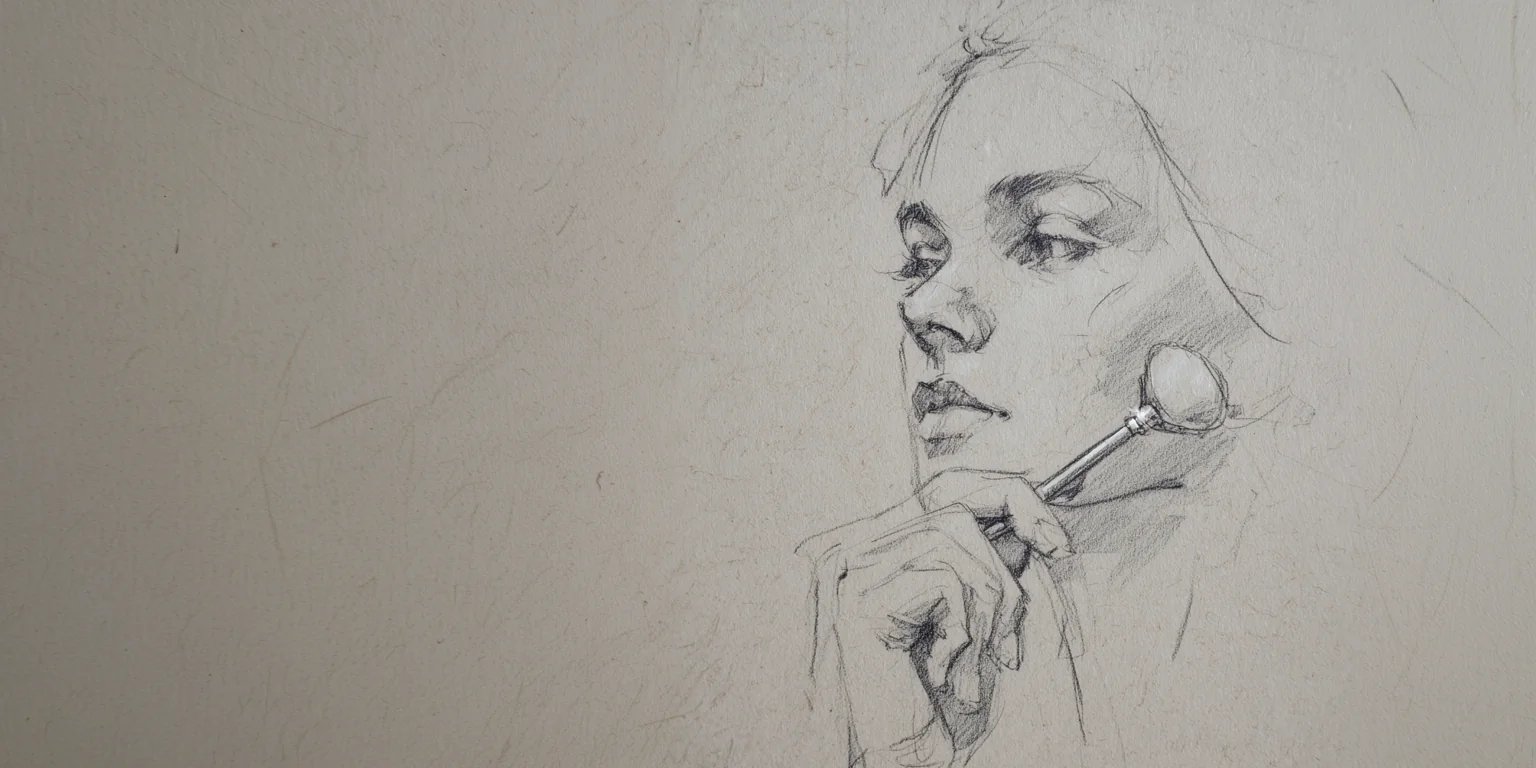
You have seen the ritual even if you have not done it yourself. A cold stone or a metal wand, ten minutes of slow passes along the jaw and up across the cheek. By the time you set it down, the face in the mirror looks a little tighter than it did when you started. Something happened. The tool is sold to you as the reason, and the reason comes with a word attached to it. Drainage. Your lymph was stuck and now it is moving. Your face was congested and now it is clear. That is the story the category is built on, and it is the part that does not hold up.
The lymphatic system is not the drain the word makes it sound like. It is a second circulation that runs quietly alongside your blood, collecting the fluid that leaks into the spaces between your cells and returning it to the vein at the base of your neck. It has no heart. What moves it is the ordinary use of your body. The muscles when you walk. The chest when you breathe. A stone on your cheek for ten minutes is not on that list.
A therapist trained in this technique uses her hands for an hour. She moves along the lymph pathways she has studied on an atlas, with a pressure just firm enough to reach vessels that sit a few millimeters under the skin. You are holding the stone yourself, over your own cheek, for ten minutes. The one clinical trial that has compared a facial roller and a gua sha tool against each other, over eight weeks of daily use, found a small measurable change in the contour of the face. The researchers attributed it to muscle tone and skin elasticity. They did not attribute it to drainage.
You slept flat for seven hours, and while you were flat, some of the fluid that usually sits lower in your body redistributed toward your face. The skin around your eyes shows it first, because that tissue is the thinnest you have. Once you are upright and moving, your own body clears it. Gravity pulls the fluid back down. Within an hour or two you would have looked the way you look after the roller, whether you picked the roller up or not. What the cold stone adds is speed. Cold constricts the blood vessels in the skin, and when the vessels are narrower, less fluid leaks out of them into the surrounding tissue. The puffiness fades faster than it would have on its own. A cold spoon on your eyes does the same thing. So does splashing cold water on your face, or stepping outside on a winter morning. The stone is a way to deliver cold to your skin. That is the part that is working.
So what is the harm in it?
The word drainage does not stop at the face. It belongs to a larger vocabulary that has been built around your body. Your lymph is sluggish. Your system is congested. Your toxins are building up. Your circulation needs help. The tool on your counter is the smallest and most polite version of that vocabulary, a stone you can hold, a ten-minute ritual that asks very little of you. What it asks of you, quietly and over time, is that you keep thinking of your body as a set of systems failing in slow, invisible ways. That you keep reaching for something to fix them. Your body is not failing. It was moving your lymph before you woke up. It was clearing the fluid from your face before your feet hit the floor. The face in the mirror was never the problem.
The stone in your hand is cold. That is what it has to offer you. The cold is the part that is working, and the rest of what you look a little more rested, a little more defined, a little more like yourself was going to happen without it. Your face was not a system in need of clearing. Your lymph was not stuck. The fluid that sat in your cheeks overnight was doing what fluid does when a body lies flat for seven hours, and your body was already handling it by the time you reached for the counter. The stone is not a lie. It is cold. Cold works. What is a lie is the vocabulary around it, the quiet suggestion that your face is a problem you are keeping on top of, one small daily intervention away from falling behind. The face in the mirror is not falling behind. It is a face, in a body that is working. The word drainage is asking you to look past that. You do not have to.

Exploring artistry and the spaces in between.
- 1. Ahn SH, Hwang UJ, Han HS, et al. (2025). Comparative Effects of Facial Roller and Gua Sha Massage on Facial Contour, Muscle Tone, and Skin Elasticity: Randomized Controlled Trial. Journal of Cosmetic Dermatology.
- 2. Scallan JP, Zawieja SD, Castorena-Gonzalez JA, Davis MJ. (2016). Lymphatic pumping: mechanics, mechanisms and malfunction. The Journal of Physiology, 594(20).
- 3. Solari E, Marcozzi C, Negrini D, Moriondo A. (2023). Biomechanical control of lymphatic vessel physiology and functions. Cellular and Molecular Immunology, 20.
- 4. Hodges GJ, Johnson JM. (2017). Pronounced and sustained cutaneous vasoconstriction during and following cryotherapy treatment: Role of neurotransmitters released from sympathetic nerves. Microvascular Research.
- 5. Ezzo J, Manheimer E, McNeely ML, et al. (2015). Manual lymphatic drainage for lymphedema following breast cancer treatment. Cochrane Database of Systematic Reviews.