Teeth have a ceiling.
There is a whitest your teeth can get. The box gets you close to it. The clinic gets you there. Past that, you are paying for damage.
You saw the photo before you did anything about it. Someone had taken it at a dinner, and you had not known it was being taken. You were laughing. The lighting was warm and the wine was red and in the photo your teeth looked a shade darker than you remembered them being. You scrolled past. A few weeks later you stopped in the aisle at the drugstore with the boxes.
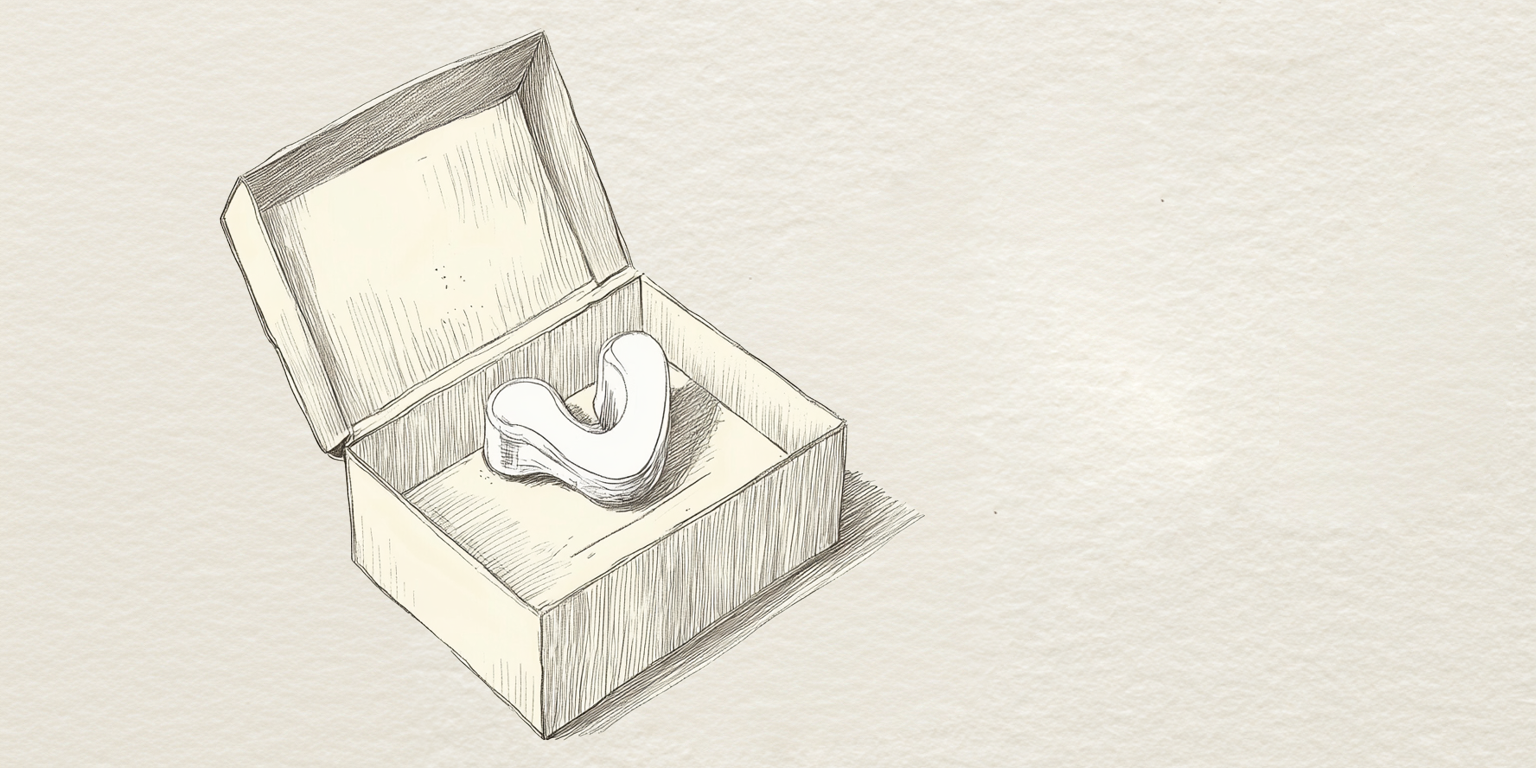
The clinic was four hundred dollars. The box was forty. You took the box home and sat on the couch for the two weeks the box told you to sit on the couch, and when the two weeks were up your teeth were a little whiter than they had been.
So what did the box actually do?
The chemical in the box is hydrogen peroxide. When you held the strip against your teeth, the peroxide crossed the surface of the enamel and reacted with the colored compounds sitting there.
Coffee, tea, red wine, tobacco. Over years, they build up in the surface of the enamel in places the toothbrush cannot reach. The peroxide breaks down the part of them that absorbs light. The tooth goes back to the color it was underneath.
Somewhere between forty-three and eighty percent of people who use peroxide feel it in the days after. A small sensitivity that was not there before. Usually gone within a few days. The box does not tell you that on the box.
So what color is the tooth underneath?
Not white.
Your teeth are made of two layers you can see. The outer layer is enamel, and it is slightly translucent. Underneath is dentin, which is naturally yellow. What you see when you look at a tooth is mostly the dentin showing through the enamel.
This is anatomy. It is how teeth are built.
The professional shade guide that dentists use to measure whitening has sixteen shades. The whitest shade on the guide is not pure white. It is a light gray.
The teeth you were born with sit somewhere on that range. They cannot become whiter than that range without something that is not whitening.
So what can the clinic do?
The same thing the box does. Faster.
The clinic uses a stronger version of the same chemical, fifteen to thirty-eight percent hydrogen peroxide. A dentist can deliver more of it in an hour than the box delivers in weeks.
A 2021 trial compared the two in a hundred and thirty people. Two weeks after treatment, the at-home group had caught up to the in-office group, and on some measures gone slightly past it. The clinic is not reaching somewhere the box cannot reach. It is reaching the same place faster.
Both are working toward the same ceiling. The ceiling is the natural color of your teeth.
So what happens if you keep going past the ceiling?
Nothing you want.
Once the peroxide has done its work on the stains, more peroxide does not produce more whitening. It produces damage.
Peroxide makes the enamel more porous. Repeated high-concentration exposure softens it, roughens the surface, and leaves it vulnerable to demineralization. Enamel does not grow back. When it thins, the yellow dentin underneath shows through more, not less. Your teeth get darker, not lighter.
The peroxide also crosses into the pulp, the nerve inside the tooth, and inflames it. This is why the sensitivity happens. It is also why the sensitivity gets worse with repeated treatments.
In a small number of people, the sensitivity becomes persistent. A dull ache in healthy teeth with no trigger. It can last months after the whitening stops.
So who is selling you past the ceiling?
Everyone.
The photo on Instagram is often not whitened teeth. It is veneers, or filters, or lighting that bleaches out the dentin entirely.
The whitening industry knows the ceiling exists. The products in the aisle and the chairs in the clinic are priced against the gap between the ceiling and what you see in the photo.
The gap is a gap you are not going to close with peroxide. The more you chase it, the more you buy. The teeth do not get whiter. Only the receipts do.
So what is the honest version?
The box works, within its range. Use it when the coffee and the wine have built up and you want them off. Follow the instructions on the box.
The clinic works, within the same range. Use it when you want the result in one visit instead of two weeks.
Stop when your teeth have reached the color they were always going to reach. That color is probably a shade or two lighter than the photo at the dinner. And probably a shade or two darker than the post on your feed.
It is the color of your own teeth at their natural ceiling.
Past that point, what you are paying for is not a whiter smile. It is thinner enamel. It is an inflamed nerve. It is a fuller receipt. The tooth has told you where it ends. The industry is selling you past that line.

Exploring artistry and the spaces in between.
- 1. American Dental Association. Oral Health Topics: Whitening.
- 2. Carey CM. (2014). Tooth whitening: What we now know. Journal of Evidence Based Dental Practice, 14 Suppl.
- 3. Kielbassa AM, Maier M, Gieren AK, Eliav E. (2015). Tooth sensitivity during and after vital tooth bleaching: A systematic review on an unsolved problem. Quintessence International, 46(10).
- 4. Luque-Martinez I, Reis A, Schroeder M, et al. (2021). Triple-blinded randomized clinical trial comparing efficacy and tooth sensitivity of in-office and at-home bleaching techniques.
- 5. Markowitz K. (2010). Pretty painful: Why does tooth bleaching hurt? Medical Hypotheses, 74(5).
- 6. Bitter NC. (1992, 1998). Studies on enamel surface alterations following bleaching. Cited in European Commission Scientific Committee review.
- 7. Josey AL, Meyers IA, Romaniuk K, Symons AL. (1996). The effect of a vital bleaching technique on enamel surface morphology and the bonding of composite resin to enamel. Journal of Oral Rehabilitation, 23(4).
- 8. National Institute for Health and Care Excellence (NICE), UK. Clinical Knowledge Summaries on tooth whitening and bleaching agents.
- 9. VITA Zahnfabrik. VITA Classical Shade Guide reference.